

Androgenetic alopecia
Androgenetic alopecia. Explained.
Androgenetic alopecia (AGA), commonly known as pattern hair loss (PHL), is the most common form of hair loss in both men (male pattern hair loss – MPHL) and women (female pattern hair loss – FPHL). 1 It arises from a combination of genetic and hormonal factors that cause progressive thinning of the hair in a characteristic pattern that differs between sexes.1 While hair loss (AGA) is a common condition, affecting an estimated 40% of men and 30% of women worldwide, it can have a profound emotional and social impact.2 Recognizing it as a medical condition, rather than a purely cosmetic concern, is an important step toward increasing understanding and awareness of its impact.
Disclaimer: Although pattern hair loss (androgenetic alopecia or AGA) occurs in both men and women, the disease awareness content presented here focuses at this time on the male phenotype of AGA only, to provide a clear, evidence-based understanding of this condition. We acknowledge that pattern hair loss also affects women and remains an important area for continued awareness and study.
The reality of hairloss
AGA affects 40% of men worldwide.2

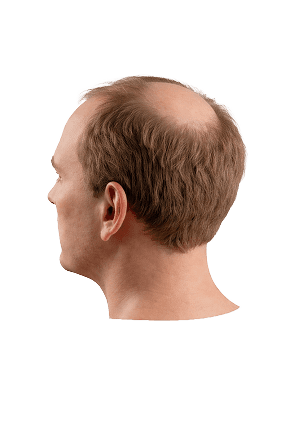
Around 25% of men with male pattern baldness begin losing hair before the age of 21.3
Different patterns, a shared condition
Up to 80% by age 70
45%
~20–45%
~35–40%
~30–35%
(Up to 50% by age 70)
Caucasian/ European1
Middle
Eastern 9
East
Asian 4,5,6
Southeast
Asian 7,8
African/
African American 10
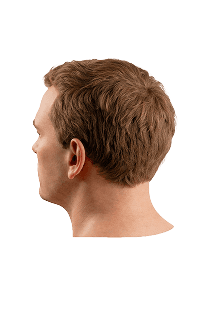
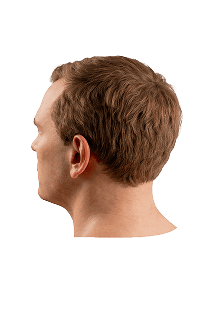
From first thinning to advanced loss
Norwood Scale
1
2
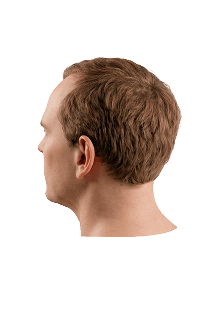
3
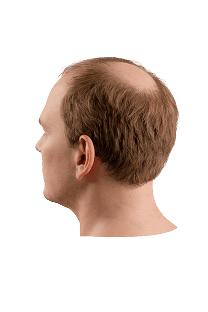
4
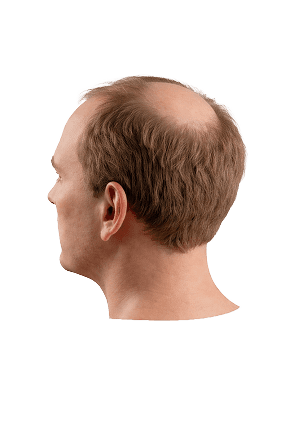
5
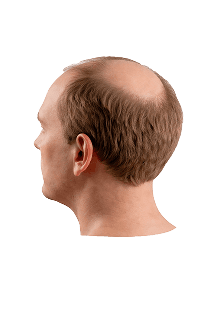
6
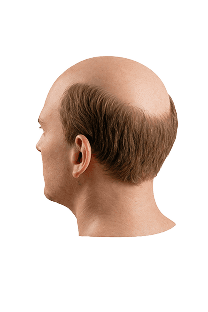
7
Scroll to the right
The needs of millions, often overlooked
Despite its high prevalence, androgenetic alopecia (AGA) is often under-discussed and under-recognized as a chronic condition. Although it affects millions of men and represents a significant area of unmet need, scientific understanding of AGA continues to evolve. In the United States alone, 65 million men experience hair loss and an estimated 43 million men seek information or medical guidance related to hair loss. 12,13,14 Currently, the only FDA-approved therapies for hair loss were approved more than 30 years ago.
Inside the biology of AGA
Androgenetic alopecia (AGA) results from a stepwise miniaturization of the hair follicle and shortening of the growth phase. Over time, this transforms long, thick, pigmented hair follicles into short, fine, unpigmented hair follicles, leading to baldness.15
In males, this process is primarily driven by androgen hormones, and mediated through the androgen receptor (AR) present in specialized cells within the follicle known as dermal papilla cells (DPC). While androgens, particularly dihydrotestosterone (DHT), normally stimulate hair production in many parts of the body, they suppress hair growth in genetically predisposed DPC in the front and top of the scalp, leading to AGA.8 Activity of androgen hormones on genetically susceptible hair follicles, leading to shortening of the growth phase and hair follicle miniaturization, represents the root cause of AGA in males.
Living with androgenetic alopecia
The speed and pattern of hair loss can vary between individuals. Over time, affected follicles may shrink and produce finer, thinner hairs. In men, androgenetic alopecia (AGA) usually begins early in adulthood, affecting approximately 22.7% of those aged 20-29 and 29.4% of those aged 30-39. 11
22.7%
Affecting approximately 22.7% of those aged 20-29.
29.4%
Affecting 29.4% of those aged 30-39.11
Recognize the symptoms
Androgenetic alopecia (AGA) is driven by well-characterized biological processes involving genetics, hormones, and follicular biology. The main symptom of AGA is a gradual, progressive hair thinning that follows a distinct pattern. Other symptoms can include an increase in shedding and a transition from thicker, pigmented hairs to thinner, shorter ones over time due to miniaturization of the hair follicle and shortening of the growth phase.8
The patient impact
For many men, hair contributes significantly to identity, self-image, confidence, and social life. The impact of androgenetic alopecia (AGA) is highly individual, depending on factors such as age, cultural background, and personal expectations.
Common beliefs about AGA include:
However, many men with AGA report:
Increased self-consciousness
Changes in grooming behaviours
Avoidance of certain social situations
Concern about how they are perceived by others
Feeling isolated on their journey
Although AGA affects a large proportion of men worldwide, conversations about hair loss are often limited, which may contribute to stigma or hesitation in seeking advice
Experiences differ from person to person, and many individuals search for information and support as they learn more about the condition.
65% of American men reported that they were highly concerned about hair loss.
Reference: Large scale national research conducted by Kline + Company on behalf of Cosmo Pharmaceuticals between Jan-May 2025 involving 3,004 participants
In their own words
Disclaimer: The experiences described are personal to the individuals featured and are shared in accordance with data protection requirements.
Ho C, Hughes J. Androgenetic alopecia. StatPearls. 2016. Available from: https://www.ncbi.nlm.nih.gov/books/NBK430924/
Mohy SM, Abozeid MF, Seoudy WM, Elshahid A, Moubasher AE, Hassan A, Elmorsy E, Hofny ER, Mohamed EM, Saleh HM, Sabry H, Gharib K, Gaber MA, Hegazy MS, Atwa MA, Moftah N, Bedair NI, Mohammed NE, Esmat S, Ameen T, Hussein T, Gohary YM, Rageh MA. Consensus recommendations for the management of androgenetic alopecia in Egypt: a modified Delphi study. Clin Cosmet Investig Dermatol. 2025;18:2651–2662. Available from: https://doi.org/10.2147/CCID.S556881
American Hair Loss Association. Men’s hair loss. American Hair Loss Association. Available from: https://www.americanhairloss.org/mens-hair-loss/
Wang, T. L., Zhou, C., Shen, Y. W., Wang, X. Y., Ding, X. L., Tian, S., Liu, Y., Peng, G. H., Xue, S. Q., Zhou, J. E., Wang, R. L., Meng, X. M., Pei, G. D., Bai, Y. H., Liu, Q., Li, H., & Zhang, J. Z. (2010). Prevalence of androgenetic alopecia in China: a community-based study in six cities. The British journal of dermatology, 162(4), 843–847. Available from: https://doi.org/10.1111/j.1365-2133.2010.09640.x
Xu, F., Sheng, Y. Y., Mu, Z. L., Lou, W., Zhou, J., Ren, Y. T., Qi, S. S., Wang, X. S., Fu, Z. W., & Yang, Q. P. (2009). Prevalence and types of androgenetic alopecia in Shanghai, China: a community-based study. The British journal of dermatology, 160(3), 629–632. Available from: https://doi.org/10.1111/j.1365-2133.2008.08909.x
Paik, J. H., Yoon, J. B., Sim, W. Y., Kim, B. S., & Kim, N. I. (2001). The prevalence and types of androgenetic alopecia in Korean men and women. The British journal of dermatology, 145(1), 95–99. Available from: https://doi.org/10.1046/j.1365-2133.2001.04289.x
Pathomvanich, D., Pongratananukul, S., Thienthaworn, P., & Manoshai, S. (2002). A random study of Asian male androgenetic alopecia in Bangkok, Thailand. Dermatologic surgery : official publication for American Society for Dermatologic Surgery [et al.], 28(9), 804–807. Available from: https://doi.org/10.1046/j.1524-4725.2002.02036.x
Tang, P. H., Chia, H. P., Cheong, L. L., & Koh, D. (2000). A community study of male androgenetic alopecia in Bishan, Singapore. Singapore medical journal, 41(5), 202–205.
Lee WS, Lee HJ. Characteristics of androgenetic alopecia in Asian. Ann Dermatol. 2012;24(3):243–252. Available from: https://www.ncbi.nlm.nih.gov/pmc/articles/PMC3412231
Tobeigei FH. Prevalence of androgenetic alopecia among Saudi population. King Khalid Univ J Health Sci. 2023;8(2):100–104. Available from: https://doi.org/10.4103/KKUJHS.KKUJHS_11_23
Patel M, Sharma A. Genetic markers associated with androgenetic alopecia in Indian males. Indian J Dermatol Venereol Leprol. 2021;87(4):456–462. Available from: https://doi.org/10.4103/ijdvl.IJDVL_123_20
Gupta AK, Wang T, Economopoulos V. Epidemiological landscape of androgenetic alopecia in the US: an All of Us cross-sectional study. PLoS One. 2025;20(2):e0319040. Available from: https://journals.plos.org/plosone/article?id=10.1371/journal.pone.0319040
Data on file. Market research. Cosmo Pharma.
Kline + Company. Large-scale national research conducted on behalf of Cosmo Pharmaceuticals; Jan–May 2025.
Lai JJ, Chang P, Lai KP, Chen L, Chang C. The role of androgen and androgen receptor in skin-related disorders. Arch Dermatol Res. 2012;304(7):499–510. Available from: https://www.ncbi.nlm.nih.gov/pmc/articles/PMC3763909